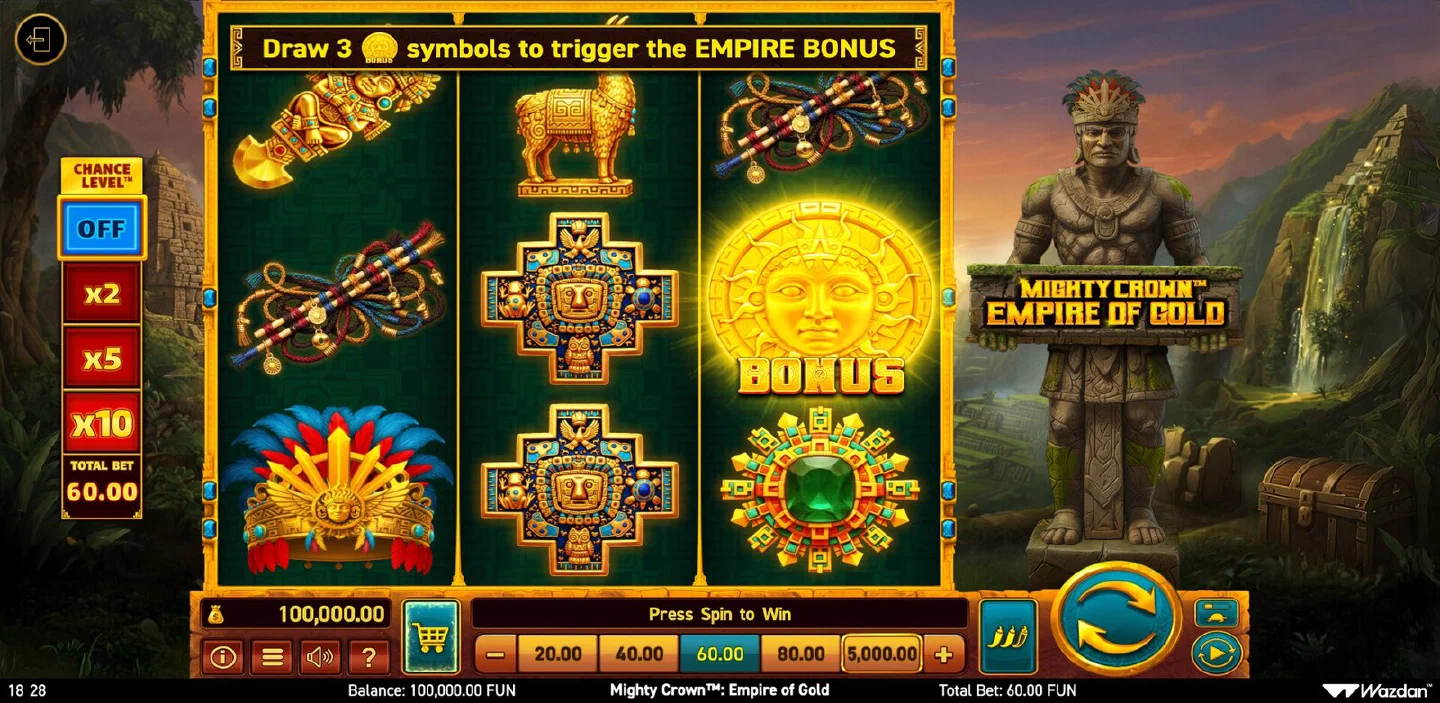
Slots with respins and sticky symbols
The Empire Bonus keeps everything on the reels and resets its counter to 3 with each new game symbol. If that is the part you play for, read how it is built before comparing it with anything.

What you like about this game decides where you go next: the respin counter, the compact grid, the five buy prices or the fact that you set the volatility yourself. Each preference leads somewhere different.
Five ways to define a neighbour, and where each one leads on this site.
| Dimension | Mighty Crown: Empire of Gold | 3 Golden Chests |
|---|---|---|
| Best for | Players who want to set the volatility level and the price of entry themselves. | Players who prefer collecting values off the grid to chasing line combinations. |
| Bonus shape | Empire Bonus: 3 respins that reset, sticky WILDs, 3x to 15x on a full grid | Prizes read from the symbol faces and collected in a hold-and-win round |
| Grid | 3 reels, 3 rows, 5 fixed bet lines | 4 reels, 3 rows, no fixed lines |
| Max win | up to 1,500x bet | up to 1,400x total bet; provider material also cites 1,500x |
| Provider | Wazdan | Endorphina |
| Rtp | 96.13% | 96.04% |
Back to the Empire Bonus
The useful question is not which slots look like Mighty Crown: Empire of Gold, but which part of it you would miss. The respin counter that resets? The grid you can read in one glance? The shop with five prices? Each answer points somewhere different, and this page sorts them.
Start with the part of the game you would notice missing. Four answers cover almost everybody who arrives here.
The respin counter. The Empire Bonus gives you 3 respins, and every new game symbol sets the counter back to 3 while all game symbols and WILDs stick to the reels. That self-extending structure is what makes the round feel like progress rather than a countdown, and it is the mechanic to search for by name: respins with sticky symbols, where the grid can only fill. A neighbour that ends its bonus on a fixed number of spins will feel different no matter how similar the theme looks.
The compact grid. Three reels, three rows, five fixed bet lines, wins leftmost to right on consecutive reels. If this is what you liked, you are looking for small formats with fixed lines rather than for 6x5 grids with thousands of ways. The trade is deliberate: you give up busy screens and get a round you can read at the fastest speed setting.
The five buy prices. A shop that runs 50x, 100x, 200x, 400x and 600x your bet is a ladder rather than a single price, and the top two levels open volatility settings that exist nowhere else in the game. Games with one buy price at one level offer a much narrower decision.
The control rail. Volatility Levels™ at Low, Standard or High plus Chance Level™ at OFF, x2, x5 and x10 mean you shape the session before the spin. That is the rarest of the four preferences, and it is where the provider’s own catalogue is the most promising place to look.
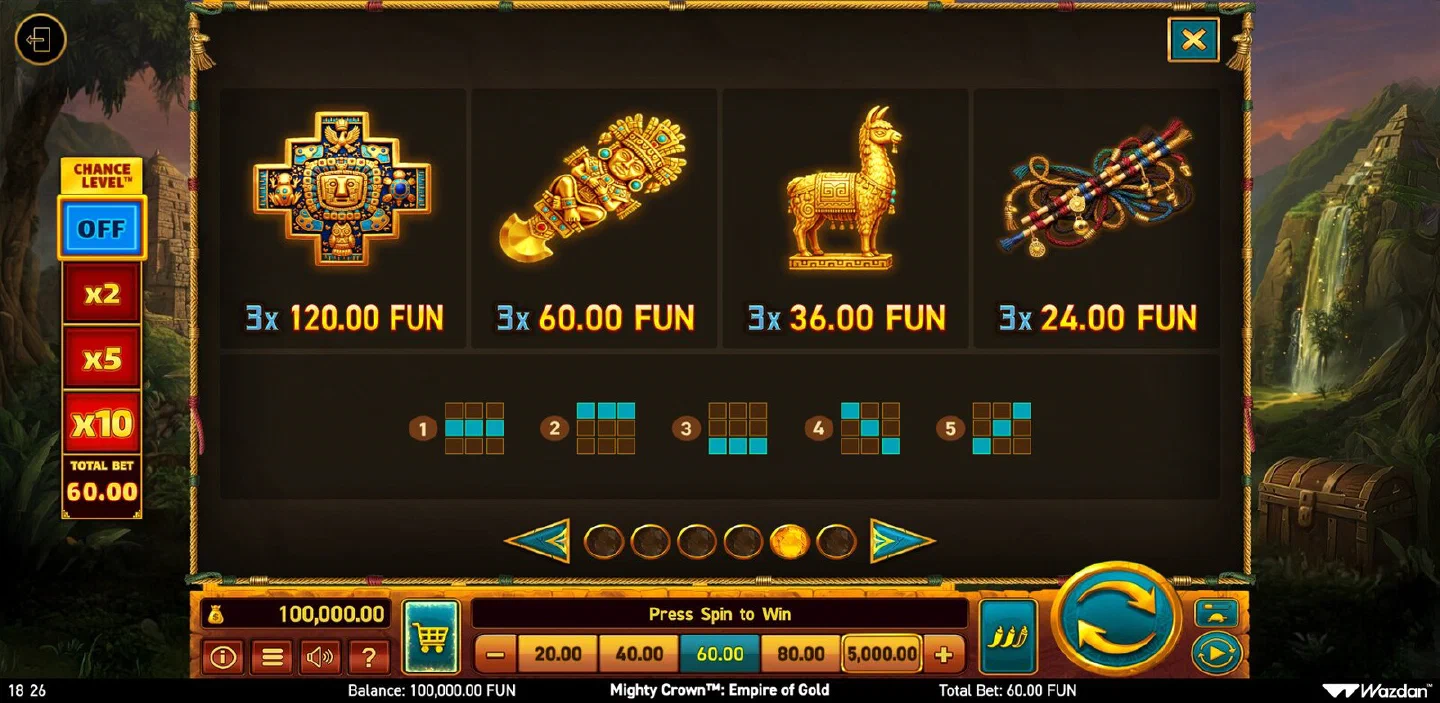
Worth adding to the list is the shape of the paytable, because it decides what “similar” feels like in a session. At a 60.00 FUN total bet the range runs from 24.00 FUN for three quipu to 1,200.00 FUN for three feather headdresses, with 36.00, 60.00, 120.00, 180.00 and 240.00 filling the space in between. A neighbour with a flatter table will feel busier and smaller; one with a steeper table will feel quieter and more dramatic. That single number, how many times the top symbol beats the bottom one, tells you more about a slot’s rhythm than its theme ever will. Here it is fifty: 1,200.00 against 24.00 FUN on the same stake. The midpoint is worth knowing too: the golden idol at 60.00 FUN returns the total bet and nothing more, which puts the headdress exactly twenty times above break-even.
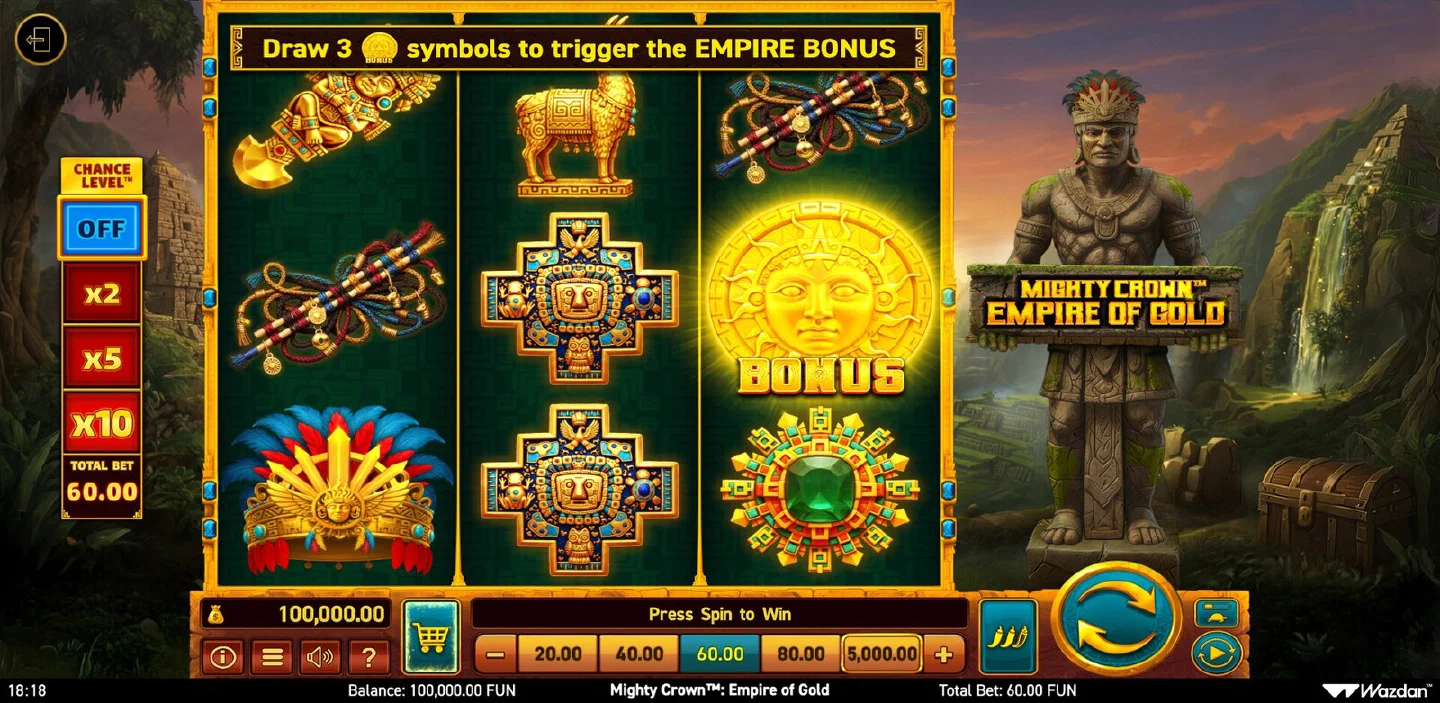
The closest relative by name is Mighty Crown™: Legacy of Mars, which the provider catalogue lists alongside this title; trade coverage describes Empire of Gold as the second Mighty Crown release of the year. Two games, one line, and a shared naming convention that decides what you type into a lobby search.
The complication is everything else that starts with the same word. Wazdan also publishes the Mighty Wild, Mighty Symbols and Mighty Hot series, and an operator page exists for a differently suffixed product with “Burning Board” attached to a similar name. None of those is this slot. If you are searching a lobby, the string that matters is the full one: Mighty Crown™: Empire of Gold, from Wazdan.
English search results add their own noise, since the phrase belongs to a music project as well as to a slot, which is why every heading on this site keeps the word “slot” or the provider’s name next to the title.
The series page takes the line and the naming question properly, including what can and cannot be said about the sibling title.

The one neighbour worth a full head-to-head is 3 Golden Chests from Endorphina. Both are compact gold-themed grids that reach a four-figure multiple of the total bet, and they get there by opposite methods.
Mighty Crown: Empire of Gold is a line game: symbols combine along five fixed lines, values are read from a paytable, and the bonus round is about filling the grid with one selected symbol while WILD multipliers accumulate. 3 Golden Chests puts money prizes on the symbol faces themselves and pays them in a hold-and-win round, so the grid is a collection surface rather than a set of lines.
Which you prefer usually comes down to how you like reading a result. Line play rewards pattern recognition and keeps the paytable in your head; prize-on-symbol play makes every landed symbol immediately legible, because the number is printed on it. Neither is more generous by design, and both live on a similar ceiling.
There is a second difference that matters more than it sounds. On a line game the bet step changes the value of a fixed table, so once you know that three headdresses pay 20x the total bet, you know what they pay at any stake you choose. On a prize-on-symbol game the numbers you read on the grid are the numbers, and the mental arithmetic runs the other way. Neither approach is harder; they simply suit different kinds of attention. The free way to find out which is yours is to open each game’s demo and watch one bonus round in each before you commit a balance to either.
The full comparison sets them side by side dimension by dimension, with both columns supported by the published figures for each game.
The last search path is the most reliable of the lot: look for the switches rather than for the artwork. Chance Level™, Volatility Levels™, the Buy Feature and Ultra Fast Mode are the four features the provider lists for this release, each under its own trademark, and knowing what they cost here is knowledge you can carry to any game that offers the same named control.
Write down what each one actually costs in this game before you use it as a yardstick elsewhere. Chance Level™ at x2 doubles the base bet for at least twice the chance at the Empire Bonus, x5 costs five times the bet for at least six times the chance, x10 costs ten times for at least thirteen; the paytable underneath never moves, so three llamas stay worth 36.00 FUN at a 60.00 FUN base bet at every step. The Buy Feature runs 50x, 100x, 200x, 400x and 600x the bet, which on a 20.00 FUN step is 1,000.00 through to 12,000.00. If the settings are what kept you here, the provider page is a better next click than any list of lookalike themes.
The same reading works in reverse when the candidate comes from another studio. Ask where its hardest volatility setting lives: here Low, Standard and High sit in the game menu, while Extreme and Double Extreme exist only behind the 400x and 600x purchases, so the two sharpest distributions in the game are things you buy rather than things you select. A candidate that hands you its whole range for free is a different proposition, and one that hides all of it behind a single price is another again.
There is one more way to choose a neighbour, and it has nothing to do with symbols: how much of the session’s tempo the game hands you.
Mighty Crown: Empire of Gold is unusually generous here. Three volatility levels are switchable while you play, two more come with the top feature-buy prices, the play speed runs from normal up to Ultra Fast Mode, and autoplay carries stop-on-win, stop-on-bonus and stop-on-balance-change conditions. Together that is a slot that can be a sharp hunt for the Empire Bonus or a quiet evening on the lower rows of the paytable, depending entirely on what you set before the first spin.
Pace also decides how a 1,500x ceiling reads. On a slow, low-volatility setting that number is a distant possibility you play towards across an evening; at High with Chance Level™ at x10 it is the explicit point of every spin, and the balance moves accordingly. Same game, same published 96.13%, two entirely different relationships with the same figure.
If that flexibility is what you liked, the criterion to search on is the rail rather than the theme: count how many things a candidate game lets you change before the spin, and how many of those changes are free. In this one, three volatility levels and three play speeds are free, the Chance Level™ steps and the five buy prices are paid, and the autoplay stop conditions cost nothing. The strategy page shows what those settings are worth in practice, the slot hub holds the whole profile of this one, and the demo lets you feel the difference between Low and High for free before you decide anything.